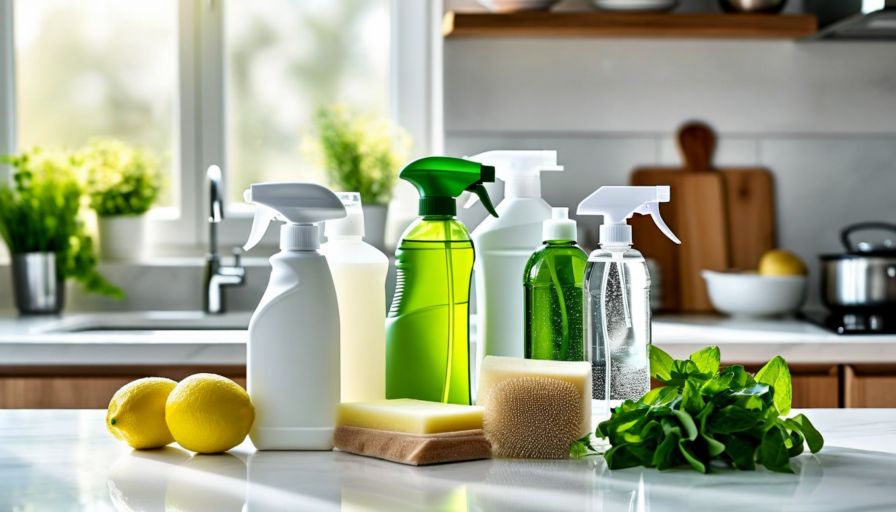
Every cleaning company with a website calls their products "eco-friendly." Most of the time, that phrase means nothing. The EPA Safer Choice certification is different — it's an actual third-party assessment of a product's ingredient profile — but the marketing around it has gotten noisy enough that many people don't know what it does or doesn't actually test.
We use EPA Safer Choice certified products in our eco-friendly package, and clients ask us about it regularly. Here's what we tell them.
What the program actually evaluates
The EPA Safer Choice program reviews the chemical ingredients in a cleaning product against the agency's database of safer chemical alternatives. To earn the label, every ingredient in the formulation must meet safety standards across four categories:
- Human health — no carcinogens, reproductive toxins, or hormone disruptors at levels of concern
- Aquatic toxicity — the product must be safe for waterways when it goes down the drain
- Persistence and bioaccumulation — ingredients must break down in the environment and not concentrate in living organisms
- Air quality — volatile organic compounds (VOCs) must be at low levels
The certification is chemical-specific. This means a manufacturer can't just claim the label — every ingredient gets reviewed individually, and products are subject to periodic re-review if formulations change. As of 2024, about 2,800 products carry the certification across roughly 430 companies.
What it doesn't test
EPA Safer Choice is not a performance certification. It doesn't test whether a product actually cleans well. A product can earn the label and be entirely ineffective against grease, soap scum, or mold. This is why the cleaning industry has products that are "green" and useless, and why some professional cleaners dismiss eco-friendly products broadly — they've been burned by products that were certified but couldn't cut through a dirty oven.
The program also doesn't cover packaging. A product can use single-use plastic containers, have no recycled content, and still earn the label because the certification only covers the chemical formulation, not the entire product lifecycle. If you're evaluating products on broader environmental grounds, the certification is one input, not the whole answer.
It's also not a certification for product concentrations in use. A Safer Choice certified concentrate diluted to an appropriate working solution is very different from the same concentrate used straight. Most cleaning professionals know this, but it's worth understanding if you're evaluating products for home use.
The products we actually use
For our eco-friendly package, we use a combination of products that carry the EPA Safer Choice certification and have been tested by our team for actual cleaning performance. The two don't always go together, and finding formulations that meet both standards took time.
Our current core products include:
- Multipurpose cleaner: Branch Basics Concentrate diluted per their recommended ratios — Safer Choice certified, genuinely effective on counters and sealed surfaces
- Bathroom disinfectant: Seventh Generation Disinfecting Spray — Safer Choice certified, EPA-registered for killing 99.9% of bacteria including Staph aureus and Salmonella
- Floor cleaner: Method Squirt + Mop Hard Floor Cleaner — Safer Choice certified, appropriate for hardwood and tile without residue buildup
- Glass cleaner: Ecover Window and Glass Spray — Safer Choice certified, streak-free on interior windows and mirrors
- Grout and tile: We use a hydrogen peroxide-based solution for grout work — not a commercial product, but a 3% H2O2 mixture which is both safe and effective as a mold treatment
Inside ovens and for heavy grease on commercial kitchen surfaces, we use conventional degreasers. This is a deliberate choice: eco-friendly formulations cannot reliably emulsify polymerized oven grease. We don't pretend otherwise. The eco package applies to all residential surfaces outside of oven interiors — clients who want their oven cleaned should expect a conventional degreaser for that specific task.
Why pet owners and parents ask for it most
The strongest driver of demand for our eco-friendly package is households with young children or pets. This makes sense. Toddlers and dogs spend time on floors, mouth objects that have been cleaned, and have smaller body masses relative to their exposure levels. The VOC concern is also real for children — studies from the Harvard T.H. Chan School of Public Health have linked frequent home disinfectant use with increased asthma and wheeze rates in children under seven.
That's not an argument against cleaning — it's an argument for being specific about what you're cleaning with. The EPA Safer Choice certification directly addresses VOC levels and toxic ingredient profiles, which is why it's the appropriate standard for households with kids and pets, not just a marketing preference.
How to evaluate "green" cleaning claims
The fastest filter: does the product appear on the EPA Safer Choice product database? The database is publicly searchable at epa.gov/saferchoice. If a company's "eco-friendly" product isn't in the database, the claim is marketing, not certification.
Second filter: does the product have a disinfectant claim? Disinfectants are EPA-registered separately from the Safer Choice program. If a product claims to disinfect — kill 99.9% of bacteria or viruses — look for an EPA registration number (format: [number]-[number]) on the label. Without that registration number, the disinfectant claim is unverifiable.
Third: is the scent artificial? Most conventional cleaning products use synthetic fragrance blends that contain phthalates and other compounds not disclosed on labels (fragrance formulas are trade secrets). Safer Choice certified products either use no fragrance or use fragrance ingredients also screened under the program. If a "natural" cleaning product has a strong synthetic-smelling fragrance, check whether the fragrance is disclosed.
Our eco-friendly package is available on any PurFresh Clean booking at no additional charge. We bring EPA Safer Choice certified products for all standard surfaces. Let us know when booking if you have specific product sensitivities or allergy considerations. Book here.